

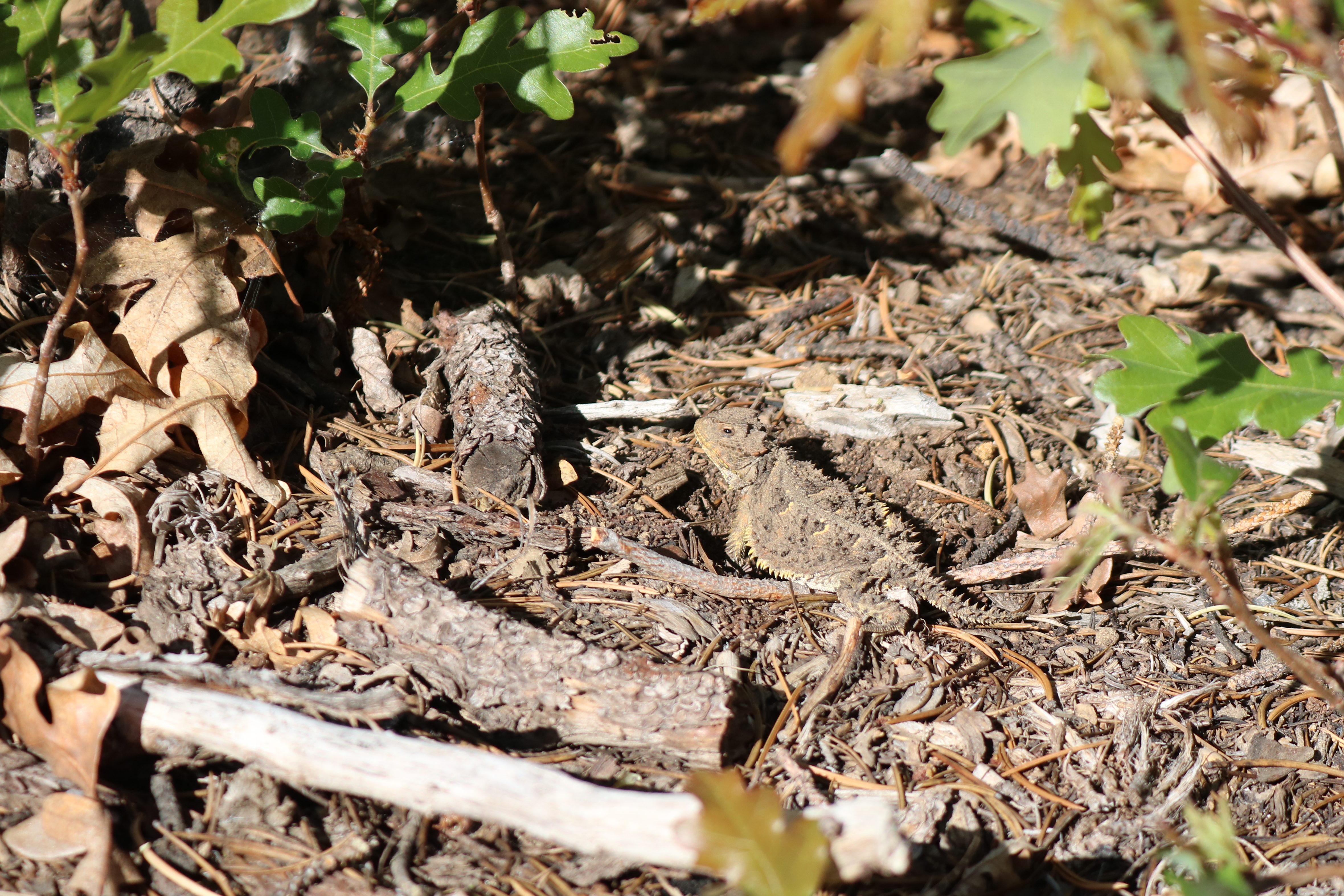
As many of you know, my background is mostly in marine mammals and marine biology. Last semester in graduate school, I took a Desert Biology course, since I knew absolutely nothing about Desert Biology. A student in the course presented on the Horned Lizard and I found it very interesting. Several weeks ago I was on my way back from a road trip to Vegas and I stayed in a yurt in a secluded area in Southern Colorado. While I was walking the property, I came across a Horned Lizard! How cool! It was very neat seeing this animal in the wild that I had learned about in school just a semester prior. I snapped a bunch of pictures, so the picture you see above is one that I took myself.
Some background information & Habitat Range: There are many different species of Horned Lizards and their habitats span throughout the United States and into northern Mexico. They live throughout much of Kansas, Texas, Oklahoma, and New Mexico. They also live in other states such as Colorado, Utah, Arizona, North Dakota, South Dakota, and Montana. Below is a habitat range map of various different species of Horned Lizards. The map on the left shows the habitat range for egg laying (meaning they lay eggs) species and the map on the right shows the habitat range for live bearing species (meaning they give live birth). The colors correspond to their scientific name, so on the map on the right, P. douglasi, P. Hernandez, etc are all the scientific names for the horned lizard species, instead of putting their common name like the Pygmy Short-Horned Lizard and Hernandez’s Short-horned Lizard . These habitat range maps only show their scientific name and not their common name, but you’re able to get an idea of where they live and can correlate the colors back to the scientific name to see exactly what species lives in that range.

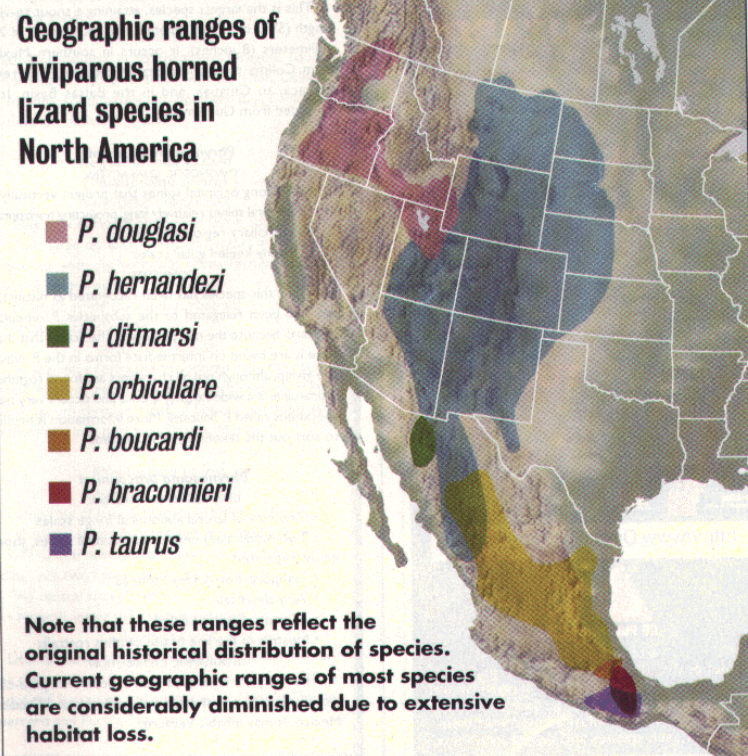
Credit: zo.utexas.edu
Predators: Predators of horned lizards include coyotes, hawks, snakes, wolves, and roadrunners.
So, what is an adaptation? Simply put, it is an evolutionary process when an organism makes changes over a long period of time to better fit into the environment in an attempt better survive in that environment. Adaptations don’t happen overnight, they occur over thousands of years to evolve. If you want to read more about adaptations, here’s a link to great informative article, you can read all about it here.
Adaptations:
These guys have some really cool and unique adaptations. I’ll save my favorite adaptation for last!
- As their name suggests, they have spikes or horns on their body. This is an adaptation to prevent getting preyed upon. See the photo below for more detail on the spikes/horns.

2. Camouflage. Their skin color blends in well with the ground, making them difficult to see by predators. The photo below is a good example of camouflage.

3. Squirt blood. This is my favorite adaptation of the horned lizard because it is so unique. Horned Lizards will squirt blood out of their eye for two primary reasons.
- If something is in their eye, like dirt or dust, they will squirt blood out of their eye to clean their eye out.
- Horned Lizards will squirt blood out of their eye, if they feel threatened in an attempt to scare off the predator. Additionally, predators, specifically coyotes and wolves don’t like the taste of this blood. They can squirt blood about 3-5 feet in distance from their eye! If you’d like to watch a video of this super cool adaptation, click here.
These adaptations not only ensure the survival of the horned lizard in harsh environments, but also highlight the fascinating diversity of life on our planet. By understanding and appreciating these remarkable traits, we can foster a deeper respect for wildlife and the delicate ecosystems they inhabit. I hope you found this article interesting! Leave me a comment with your favorite adaptation of the horned lizard.
 Action Fauna Blog
Leave a comment