

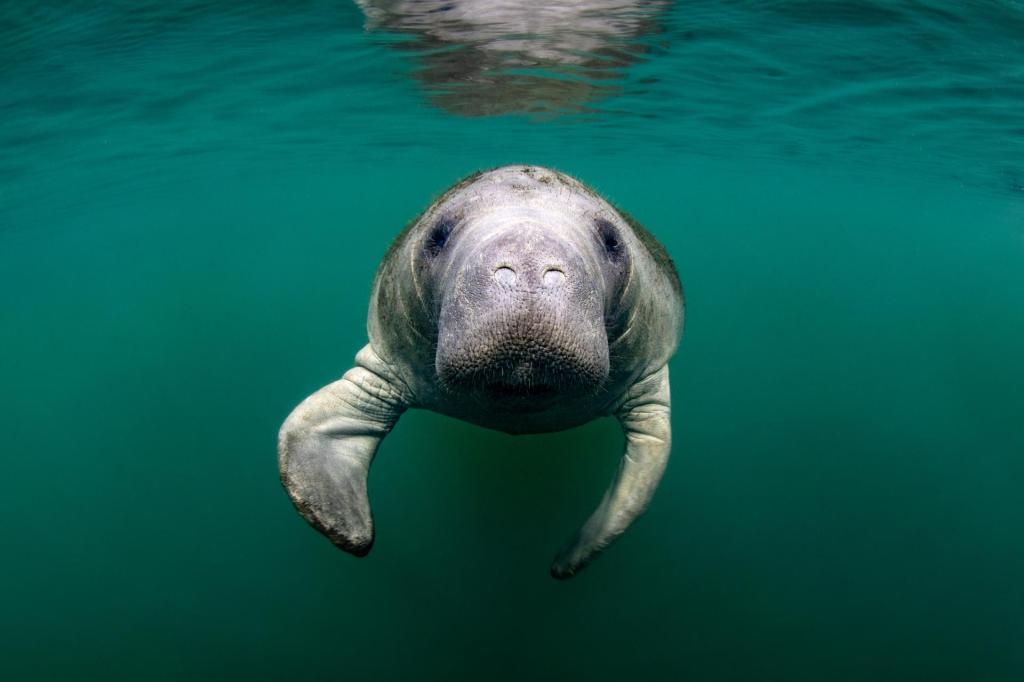
There are numerous threats facing Florida Manatees. Please know that this blog post will only cover a handful. If you would like to understand why manatees are important to the ecosystem and why it is important to help save them, click here to read a blog post I wrote discussing this.
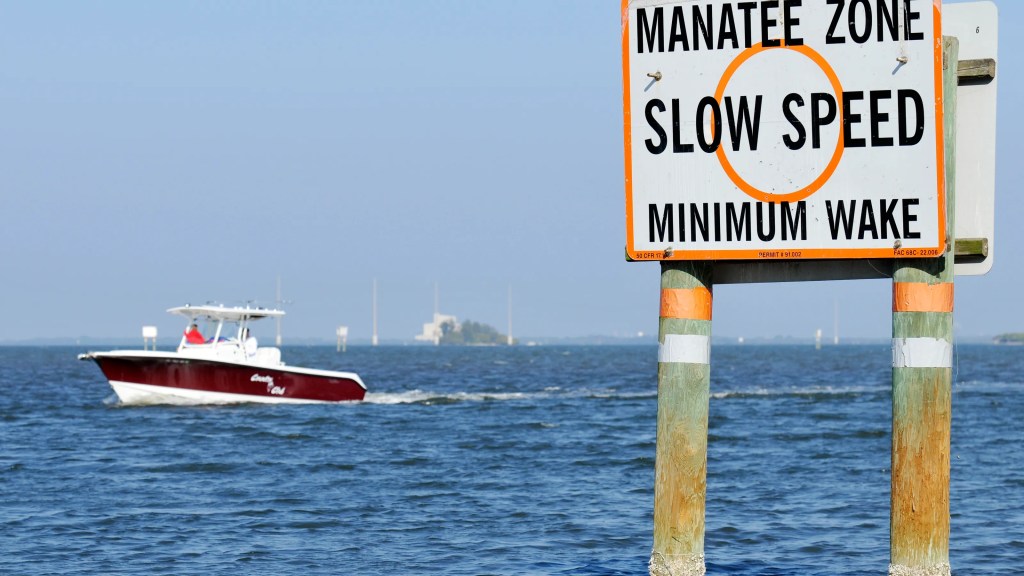
Watercraft Collisions: One of the biggest threat to Florida Manatees is watercraft collisions. If you look at any wild manatee you will see that they have many scars on their backs. Most of these scars (not all) are from watercraft collisions. Fun Fact: We actually visually identify manatees based on the scarring on their back. The images below are great examples of watercraft related scars.


Scarring on manatees caused by watercraft. Credit: David Schrichte
Most, if not all, watercraft collisions occur due to poor boating operation. Manatees are at no fault of this. Poor boating operation includes, but not limited to: not following posted speed limit signs, speeding through no wake zones, boating through shallow water, & boating through seagrass beds.
A ten year study published in 2020, linked here (Open access as of July 2024), examined scarring on manatee carcasses and they found that only 4% of the adult manatees carcasses that they examined did NOT have watercraft related scars. The study also found that 1 in 4 adult manatee carcasses had at least 10 watercraft related scars. This is exactly why safe boating practices are vital to the survival of manatees.
A little note on reporting manatees: It is important for boaters and bystanders to report a sick, injured, tagged, or dead manatee to Florida Fish & Wildlife Conservation Commission (FWC). This is so that FWC can rescue the manatee and take it to a rehabilitative facility, if needed. The FWC Alert Toll-Free phone number to report a sick, injured, tagged, or dead manatee is: 1-888-404-FWCC (1-888-404-3922), press “7” to speak with an operator.
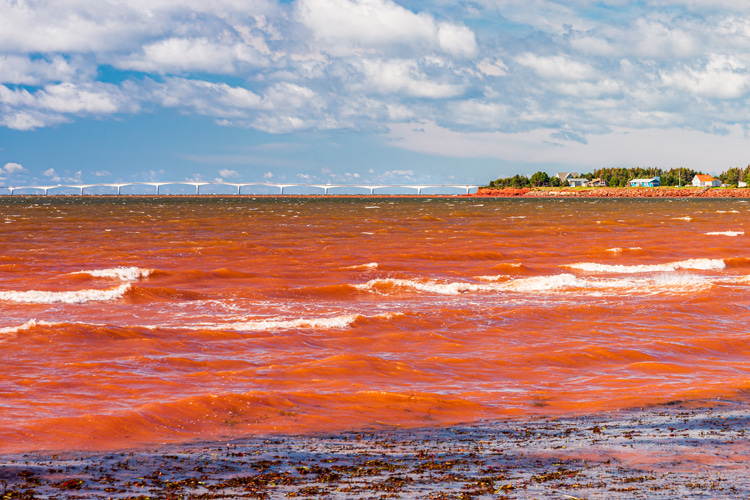
Red Tide or Harmful Algal Blooms (HABs): If you want to learn more about red tide, click here for an article that I wrote recently that goes more depth on the topic. Red tide has been shown to lower lymphocyte proliferation (part of your white blood cells within the immune system), which can lower a manatee’s ability to fight off infections. Additionally, red tide has also been shown to cause oxidative stress. Oxidative stress can lead to inflammation, free radicals, and tissue damage. (Walsh et al., 2015) Click here to read the study on this, unfortunately the entire study is not open access, but some of it is. Red tide can also seizures in manatees and this can result in drowning.
As discussed in the article that I wrote, there are some main contributors to red tide including fertilizer and sewage treatment facility runoff. Limiting this would result in fewer & less intense red tide events which would be of great benefit to not only manatees, but humans, as well as the entire marine ecosystem, including all marine animals and aquatic plants.
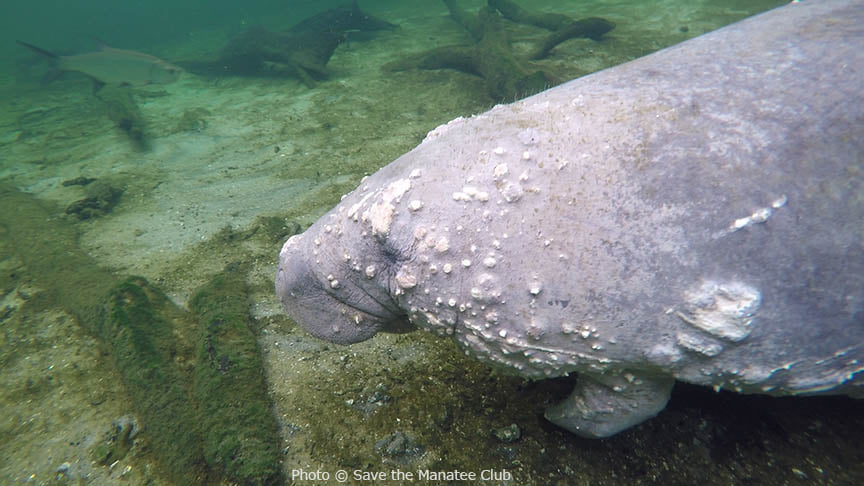
Cold Stress: If you look at the image above you will see that this manatee has white lesions on its body. These white lesions are caused by something called cold stress. Cold stress is similar to hypothermia. It usually occurs in manatees when the water temperature drops below 68 degrees Fahrenheit for an extended period of time. Cold stress usually occurs in the winter due to the cooler temperatures. Cold stress lesions can also cause scarring on a manatee. When water temperatures dip below 68 degrees Fahrenheit manatees will actually move to warmer water areas, but due to habitat loss, that isn’t always possible.
Why can’t manatees handle colder waters? Manatees have a slower metabolism and less fat than other marine mammals, which means they produce less body heat making them vulnerable to cold stress.
What happens when a manatee has cold stress syndrome? Manatees develop the white lesions as seen in the image above. They can also have bleaching on their skin or weeping sores. Cold stress can lead to significant weight loss to the point of becoming emaciated. Manatees also can become immunocompromised and are more lethargic. Due to this, they become more susceptible to disease and illness as well as to watercraft collisions due to lethargy.
Habitat Loss: As you learned when reading about Cold stress, manatees need warm water to survive, which is water above 68 degrees Fahrenheit. So what happens when water temperatures dip below 68 degrees Fahrenheit and manatees have no where to go to get to warmer waters? Habitat loss can be a cause of this. Losing warm water areas for manatees is detrimental to them and their survival. Coastal development is a cause of habitat loss.
Climate Change: Climate change has resulted in more frequent and intense storms, most notably hurricanes. For manatees, death may be a result due to changes in the ecosystem from these more intense and frequent storms. More frequent and stronger rainfall will result in more runoff, which will most likely result in more frequent red tide events. Hurricanes are known to disturb sea grass beds, which make up most of a manatee’s diet. Hurricanes can also result in debris, sewage, and red tide, which are all harmful to manatees.
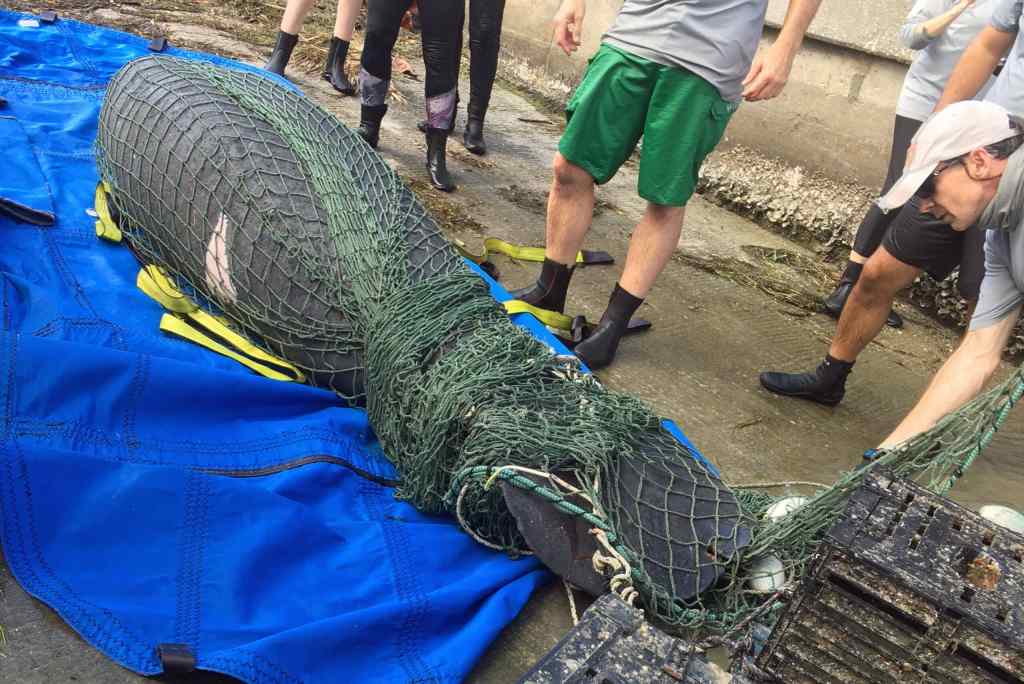
Fishing Net Entanglement: The above image shows a great example of a manatee tangled in fishing net. Fishing net entanglement is an unfortunate threat to manatees. They can get caught and tangled in the net and even ingest it or they be a result of bycatch. Bycatch is when marine animals get caught in the fishing net unintentionally while fishermen are trying to catch another species. A 20 year study (1993-2012) looking at live manatee rescues and necropsy reports found that from the necropsy reports, which were over 6,500, over 11% ingested fishing gear or experienced entanglement or both. (Reinert et al. 2017) From the live manatee rescues, over 25% were as a result of ingestion or entanglement in fishing gear or marine debris. (Reinert et al. 2017) Click here to read the study (Open access as of July 2024).
An additional note on seagrass: Most of a manatee’s diet is made up of seagrass and losing seagrass would be detrimental to them. Some threats to seagrass beds are: pollution, runoff, red tide, boating over seagrass beds, coastal development, climate change, and invasive species.
I hope after reading this blog post you understand the threats facing manatees and that all of these threats are from human behavior. It is not too late to change our behaviors! I want this post to inspire you to make changes for the betterment of the environment, ecosystem, and society as a whole. Manatees have done nothing to deserve this, they have simply been existing while we destroy their habitats and cause extreme harm to them. I also hope that this post invokes a conservation with your friends, family, coworkers, etc about this because this is such an important topic. Let me know in the comments if you plan to change any behaviors, if you learned something new, and/or your thoughts and reflections.
Citation: Reinert, Thomas & Spellman, AC & Bassett, BL. (2017). Entanglement in and ingestion of fishing gear and other marine debris by Florida manatees, 1993–2012. Endangered Species Research. 32. 10.3354/esr00816.
 Action Fauna Blog
Leave a comment